
 By guestpostupmy@gmail.com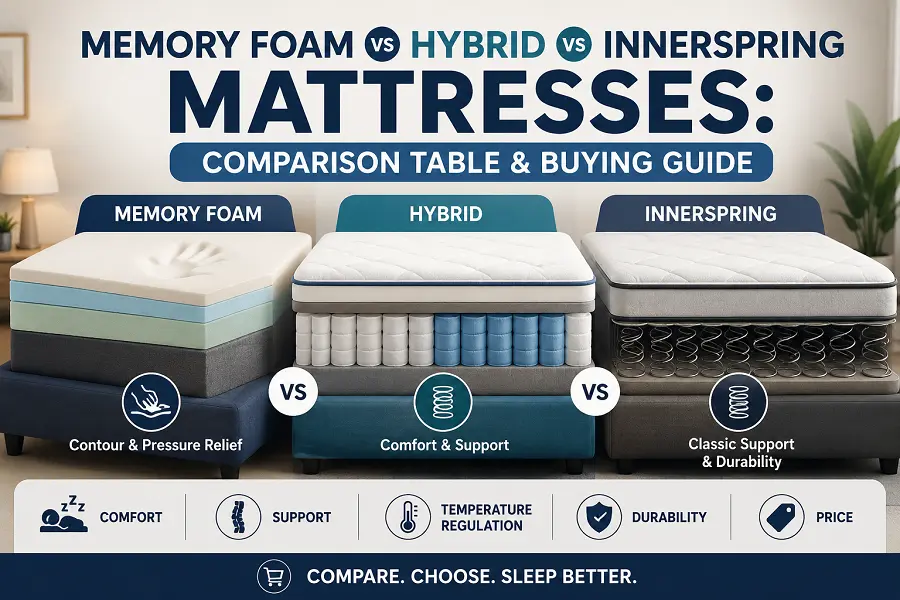
So, Which Mattress Type Actually Wins?
Short answer: none of them “win” outright — it depends on how you sleep, how much you weigh, and honestly, how hot you run at night. But if you want the quick version before we get into the weeds — hybrid mattresses tend to work best for most people because they blend the pressure relief of foam with the support and bounce of springs. Memory foam is the pick if you sleep on your side and want that sink-in hug. Innerspring is for people who want a firmer, bouncier, budget-friendly bed and don’t mind a bit less contouring.
That’s the gist. Now let’s actually break down why, because a one-line answer isn’t going to help you when you’re standing in a mattress showroom getting talked at by a salesperson.
I’ve gone through three mattress swaps in my own home over the past six years — one innerspring that came with our first apartment, a memory foam bed-in-a-box that I bought during a sale, and now a hybrid that I’ve had for about two years. Each one taught me something the marketing copy conveniently leaves out.
Memory Foam vs Hybrid Mattresses: Comparison Table
Here’s the table most people searching for this actually want — a straightforward side-by-side so you don’t have to read five paragraphs to get one answer.
| Feature | Memory Foam | Hybrid | Innerspring |
|---|---|---|---|
| Feel | Deep contouring, slow sink-in | Contouring on top, springy underneath | Firm, bouncy, minimal contouring |
| Motion isolation | Excellent | Good to very good | Poor |
| Edge support | Weak to moderate | Good | Moderate |
| Temperature retention | Runs warm (unless gel-infused) | Sleeps cooler due to airflow | Sleeps coolest |
| Pressure relief | Best for side sleepers, joint pain | Balanced, good for combo sleepers | Least pressure relief |
| Durability | 8–10 years typically | 6–8 years typically | 5–7 years typically |
| Average price range | ₹15,000–₹45,000 | ₹20,000–₹60,000 | ₹8,000–₹25,000 |
| Best for | Side sleepers, couples wanting quiet nights | Back/combo sleepers, people who overheat on foam | Budget buyers, back sleepers, people who like a firm bed |
| Noise | Silent | Mostly silent, occasional coil creak over years | Can creak as it ages |
| Off-gassing smell | Noticeable for first few days | Mild | Minimal |
A quick note on that price range — it shifts a lot by brand and thickness, so treat it as a ballpark, not gospel. I’ve seen hybrid mattresses priced lower than some premium all-foam ones, especially during sale seasons.
What Each Mattress Type Actually Feels Like to Sleep On
Memory Foam: The Slow Hug
Memory foam reacts to body heat and weight, so it slowly molds around you. Lie down and wait about thirty seconds — you’ll feel it soften right under your hips and shoulders while staying firmer everywhere else. That’s genuinely great if you have shoulder or hip pain from side-sleeping.
The catch? It traps heat. My old memory foam mattress didn’t have any cooling gel layer, and summer nights were rough — I’d wake up sweaty more nights than I’d like to admit. Newer foams with gel infusion or open-cell structures have gotten better at this, but “better” doesn’t mean “cool.” If you’re a naturally warm sleeper, keep this in mind before you fall for the comfort description.
Hybrid: The Middle Ground That Mostly Delivers
A hybrid mattress puts a foam or latex comfort layer on top of a pocketed coil support system. You get some of that foam contouring without losing the bounce and airflow that springs provide.
This is what I sleep on now, and it’s the first mattress where my partner and I haven’t argued about temperature. She runs cold, I run hot — the hybrid seems to split the difference better than either of our previous foam mattresses did. That’s not scientific, just two people’s real experience, but it lines up with what most sleep researchers say about coil-based airflow.
The one downside worth mentioning: hybrids are heavier and more expensive to manufacture, so they usually cost more than a comparable all-foam bed. If budget is tight, this matters.
Innerspring: The Classic, Still Around for a Reason
Innerspring mattresses are what most of us grew up sleeping on. Steel coils for support, a thin comfort layer on top — sometimes just an inch or two of padding. They’re bouncy, firm, and sleep cool because air moves freely through the coil structure.
What people underestimate is how quickly the comfort layer can wear thin, especially on cheaper models. You might get a great first year, then start feeling coils through the padding by year three or four. If you go this route, spend a little more for a thicker comfort layer — it makes a real difference in how long the mattress feels good.
How to Pick Based on How You Actually Sleep
Rather than another generic list, let’s go by sleep position and body type, since that’s what actually determines fit:
- Side sleepers under 130 lbs: Memory foam or a soft hybrid. You need pressure relief at the shoulder and hip without sinking too deep.
- Side sleepers over 200 lbs: A medium-firm hybrid. Pure memory foam can feel like quicksand at higher body weights, and you’ll lose support over time.
- Back sleepers: Medium-firm hybrid or a supportive innerspring. You want your spine kept in a neutral line, not curved into a foam dip.
- Stomach sleepers: Firm innerspring or firm hybrid. Anything too soft will let your hips sink and strain your lower back.
- Combo sleepers (change position through the night): Hybrid, hands down. You need the responsiveness to move easily, which memory foam resists.
- Couples with different preferences: Hybrid with good motion isolation, or consider a mattress with dual firmness zones if your budget allows.
None of this is a hard rule — I know plenty of stomach sleepers who love soft memory foam and are perfectly fine. But if you’re buying blind, especially online, these are reasonable defaults.
What Nobody Tells You Before You Buy
A few things I learned the hard way:
Trial periods matter more than reviews. Most online mattress brands now offer 60–100 night trials. Use the full window. Your body needs at least two to three weeks to adjust to a new mattress — judging it in the first three nights is a mistake I made with my first memory foam bed, and I almost returned a mattress that turned out fine once I got used to it.
“Firm” and “soft” aren’t standardized. One brand’s medium-firm is another’s soft. Don’t trust the label alone — read the specific firmness rating (usually on a 1–10 scale) if the brand provides one.
Mattress toppers can fix minor mismatches. If you’re stuck with a mattress that’s slightly too firm or too soft, a topper is a far cheaper fix than replacing the whole thing.
Weight matters more than most guides admit. A mattress rated “medium” for a 150 lb person will feel noticeably firmer to someone at 220 lbs, since heavier bodies compress foam and coils more. Factor your weight in, not just your preferred feel.
A Quick Word on Price vs Value
It’s tempting to assume the priciest mattress is the best one. That hasn’t matched my experience. My hybrid cost less than a premium memory foam model I almost bought instead, and it’s held up better after two years — no sagging, no noticeable dip where we sleep. Read return policies and warranty terms carefully; a 10-year warranty sounds great until you notice it only covers manufacturing defects, not normal sagging, which is usually what actually happens over time.
Final Take
If you want one mattress type to default to without overthinking it, hybrid mattresses are the safest all-around choice for most sleepers in 2024 and beyond — they balance comfort, support, and temperature better than either pure foam or pure spring options. But “safe” isn’t the same as “best for you.” If you already know you love the sink-in feel, memory foam still does that better than anything else. And if budget or a preference for firm, bouncy support drives your decision, a good-quality innerspring is still a completely reasonable choice — not an outdated one.
Test a few in person if you can, use the trial period if you buy online, and give your body time to adjust before deciding it’s wrong for you.
Frequently Asked Questions
1. Which is better, memory foam or hybrid mattress?
Neither is universally “better” — memory foam offers deeper pressure relief and motion isolation, while hybrids offer better airflow, bounce, and edge support. Your sleep position and body weight should guide the choice.
2. Is a hybrid mattress worth the extra cost over memory foam?
For most people, yes, especially if you sleep hot or share a bed with someone who moves a lot at night. The extra cost buys better temperature regulation and durability.
3. Do innerspring mattresses still make sense in 2024?
Yes, particularly for stomach and back sleepers who want firm support and cooler sleep, and for budget-conscious buyers. They’ve improved with thicker comfort layers compared to older models.
4. Which mattress type is best for back pain?
Medium-firm hybrid mattresses are generally recommended for back pain since they support spinal alignment while still relieving pressure points. Memory foam works too if it’s not overly soft.
5. Do memory foam mattresses sleep hot?
Traditional memory foam does retain heat. Gel-infused or open-cell foam versions perform better, but even those usually run warmer than hybrid or innerspring options.
6. How long do hybrid mattresses last compared to memory foam?
Hybrids typically last 6–8 years, slightly less than memory foam’s 8–10 years, mainly because the coil layer can wear down faster than solid foam.
7. What’s the average price difference between memory foam and hybrid mattresses?
Hybrids usually cost 15–30% more than comparable memory foam mattresses due to the combined coil-and-foam construction.
8. Which mattress is better for couples?
Hybrid mattresses generally work best for couples because they combine motion isolation with enough bounce for easy movement, plus better edge support for shared use.
9. Can I find memory foam vs hybrid mattress comparisons near me in stores?
Most major mattress retailers and furniture stores carry both types in showrooms, letting you physically test them before buying — worth doing if you’re unsure about firmness preference.
10. Are there reliable memory foam vs hybrid mattress comparison charts online?
Yes, most mattress brands and independent review sites publish comparison charts, though it’s worth cross-checking specs like firmness rating and coil count rather than relying on marketing claims alone.
11. What do people on Reddit say about memory foam vs hybrid mattresses?
discussions on forums like Reddit often echo expert advice — hot sleepers and back sleepers tend to prefer hybrids, while side sleepers with joint pain often favor memory foam, though opinions vary widely based on individual body type.
12. When is the best time to buy a mattress on sale?
Major sales typically happen around Labor Day, Black Friday, and end-of-season clearances, when discounts on both memory foam and hybrid mattresses can range from 20–40%.
13. How do I know if a mattress is too firm or too soft for me?
If you wake up with lower back pain, the mattress may be too firm for your body weight and sleep position. If you sink in and struggle to change positions, it’s likely too soft.
14. Do mattress toppers work to change firmness?
Yes, a topper can add softness to a firm mattress or, less effectively, add slight extra support with a firmer topper. It’s a budget-friendly way to adjust feel without replacing the mattress.
15. What’s the difference between a hybrid and a pillow-top innerspring mattress?
A pillow-top innerspring has a thick padded layer stitched onto a traditional coil base, while a hybrid uses engineered foam or latex layers bonded to pocketed coils — hybrids generally offer more consistent support and durability.