
 By guestpostupmy@gmail.com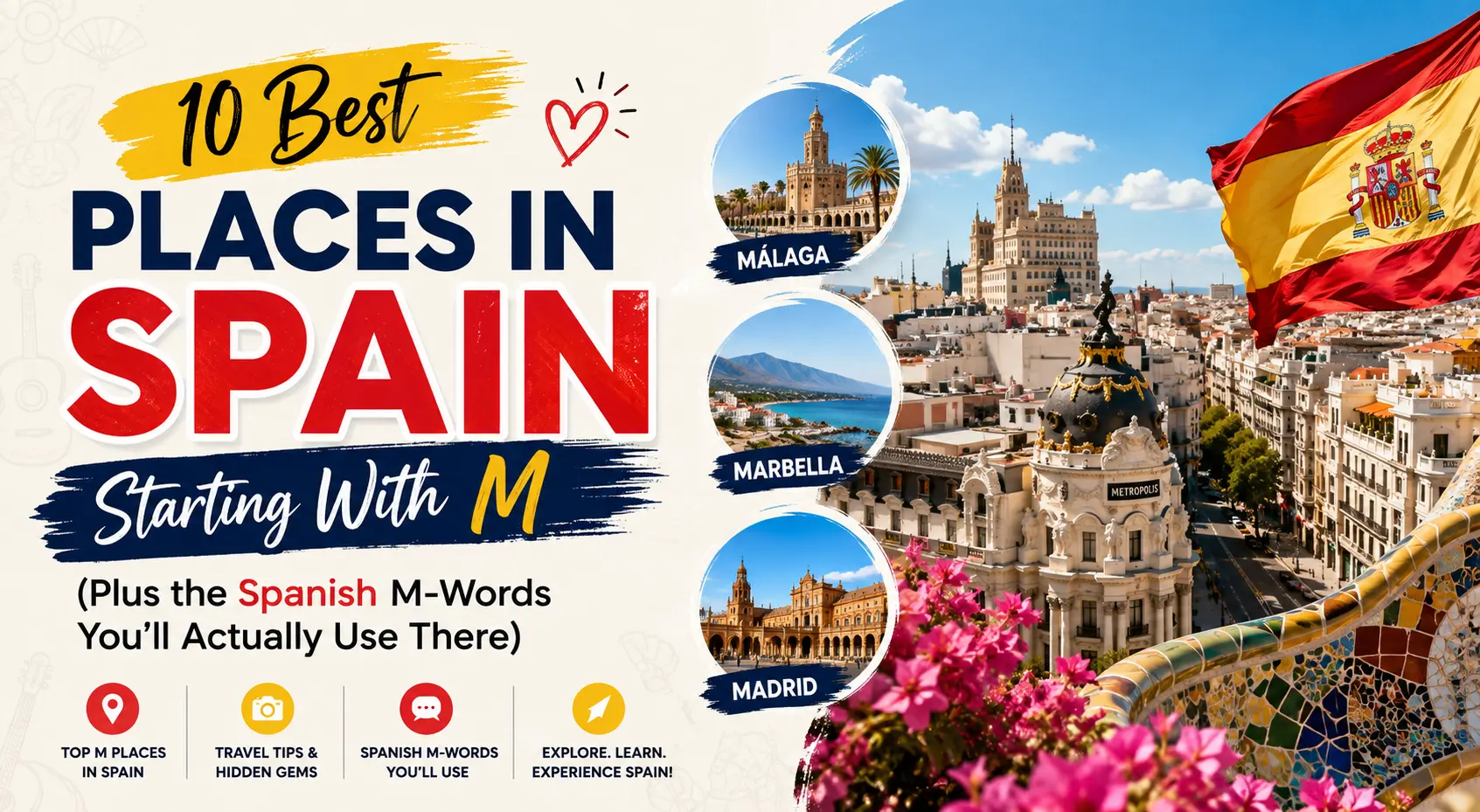
If you’ve typed “places in Spain starting with M” into Google, chances are you’re either planning a trip, doing a Spanish homework assignment, or both. I’ve been down that exact rabbit hole myself — once while planning a two-week Spain trip on a shoestring budget, and once while helping my niece cram for a Spanish vocabulary quiz the night before it was due. Turns out the two searches overlap more than you’d think, so this guide covers both: the cities and towns worth your time, and the Spanish M-words that’ll actually come in handy when you’re there.
Let’s get into it.
Quick Answer: Best Places in Spain Starting With M
If you only remember three names from this article, make them Madrid, Málaga, and Mallorca. Madrid gives you the capital-city energy and world-class art museums. Málaga is the Costa del Sol’s underrated gem (Picasso was born there, and the food scene has exploded in the last decade). Mallorca is the island escape when you want beaches without leaving Spanish soil.
Now, the full list — and yes, I’ve actually been to most of these, not just read about them.
10 Places in Spain Starting With M You Should Visit
1. Madrid
Spain’s capital doesn’t need much of an introduction, but here’s what surprised me: it’s far less touristy-feeling than Barcelona once you get past Sol and Gran Vía. The Prado Museum alone can eat a full day if you’re into art, and the tapas crawl through La Latina neighborhood on a Sunday afternoon is one of those experiences that just works — locals and travelers mixed at the same bar counters, nobody rushing.
2. Málaga
I’ll be honest — I almost skipped Málaga on my first trip because I assumed it was “just a beach town.” Big mistake. The Alcazaba fortress overlooking the harbor, the Picasso Museum, and a genuinely walkable old town make it worth two or three nights minimum, not a day trip from the coast.
3. Mallorca (Majorca)
Part of the Balearic Islands, Mallorca gets lumped in with party-island Ibiza, but the interior — think Valldemossa and the Serra de Tramuntana mountains — is quiet, olive-grove country. If someone tells you Mallorca is only for nightlife, they haven’t left Palma.
4. Marbella
Marbella is where old-money Spain and new-money tourism collide. Puerto Banús has the yachts and designer shops, but Marbella’s old town — narrow whitewashed streets, orange trees, small plazas — feels closer to how the whole region looked before the resorts arrived.
5. Mérida
This one rarely makes the “top places in Spain” lists, which honestly baffles me. Mérida has one of the best-preserved Roman theatres outside Italy, and it’s still used for live performances every summer. If you care about history and hate crowds, this is your spot.
6. Murcia
Murcia gets overshadowed by its flashier coastal neighbors, but the city itself has a striking Baroque cathedral and a food culture built around fresh produce from the surrounding “huerta” (orchard region). It’s also just cheaper than most tourist-heavy cities, which matters if you’re budgeting.
7. Menorca
The calmer, less-photographed sibling of Mallorca and Ibiza. Menorca’s beaches (calas) are some of the most turquoise water you’ll see in the Mediterranean, and development is deliberately kept low-key — there’s a reason it’s a UNESCO Biosphere Reserve.
8. Medina Azahara (near Córdoba)
Technically the ruins of a 10th-century Moorish palace-city just outside Córdoba. It’s not a full “town” you’d stay in, but it’s a place name starting with M that deserves a mention — and honestly, walking through the ruins gives you a better feel for Al-Andalus history than most museums do.
9. Mijas
A whitewashed “pueblo blanco” in the hills above the Costa del Sol. Mijas is touristy, sure, but it earns it — donkey rides through cobblestone streets and views over the coastline that photos genuinely don’t do justice.
10. Montserrat
Not a town exactly, but a mountain and monastery outside Barcelona that’s become a day-trip staple for good reason. The jagged rock formations look almost artificial, and the monastery’s boys’ choir (when performing) is worth timing your visit around.
Why “M” Places Keep Popping Up in Spain
Here’s something I didn’t expect until I actually mapped these out: a huge chunk of Spain’s most visited destinations start with M, partly because of Moorish and Roman naming conventions that stuck around (Medina, Mérida, Málaga all trace back centuries), and partly just coincidence. Either way, if you’re building an itinerary around the letter M as a fun constraint, you’re not short on options.
Spanish Words That Start With M (The Ones You’ll Actually Use)
Now for the vocabulary side of this — because if you’re traveling to any of the places above, a handful of M-words will get more mileage than a phrasebook full of formal grammar.
Common M spanish words for everyday travel:
- Maleta — suitcase
- Mañana — morning / tomorrow
- Mercado — market
- Mar — sea
- Museo — museum
- Montaña — mountain
- Mesa — table
- Mapa — map
Adjectives in Spanish that start with M (these are the ones that’ll make you sound less like a phrasebook and more like a person):
- Maravilloso — marvelous
- Moderno — modern
- Malo — bad
- Mejor — better
- Mucho — a lot / much
- Mismo — same
A quick tip from personal trial and error: mañana is one of the most useful — and most misleading — words you’ll learn. It technically means “tomorrow,” but in casual conversation, especially outside Madrid, it’s often used loosely to mean “later, whenever.” Don’t panic if a shopkeeper says your order will be ready “mañana” and it takes two days. That’s just how it works.
A Few Honest Caveats
I don’t want to oversell this. Some of these towns — Marbella and Mijas especially — can feel overrun in peak summer (June through August), with prices that spike accordingly. If you’re chasing an authentic, uncrowded experience, aim for shoulder season (April–May or September–October) instead. And Mérida, while incredible historically, has very little going on after dark, so don’t plan it as your nightlife stop.
Final Thoughts
Whether you searched for this because you’re planning a Spain itinerary or brushing up on Spanish words that start with M for a class, the overlap makes sense — travel and language learning tend to feed each other. My honest recommendation: if you can only pick three of these towns, go with Madrid for the culture, Málaga for the food and history combo, and Mérida if you want to feel like you discovered something most tourists miss.
FAQs
1. What is the most popular place in Spain starting with M?
Madrid, by a wide margin — it’s the capital and Spain’s most visited city overall.
2. Are Mallorca and Menorca the same place?
No, they’re separate islands in the Balearic archipelago. Mallorca is larger and busier; Menorca is quieter and less developed.
3. Is Málaga worth visiting or just a beach town?
It’s worth visiting on its own merits — the old town, Picasso Museum, and Alcazaba fortress make it more than a beach stopover.
4. What are some easy Spanish words that start with M for beginners?
Mesa (table), mapa (map), mañana (morning/tomorrow), and mucho (a lot) are good starting points.
5. What does “mañana” really mean in Spanish?
Literally “tomorrow” or “morning,” but colloquially it can also mean “at some point later,” especially in relaxed or informal settings.
6. Are there adjectives in Spanish that start with M I should learn first?
Start with mejor (better), mucho (much/a lot), and moderno (modern) — they’re versatile and used constantly.
7. Is Mérida in Spain the same as Mérida in Mexico?
No, they’re different cities. This article refers to Mérida in Extremadura, Spain, known for its Roman ruins.
8. What’s the best time to visit Marbella or Mijas?
April–May or September–October, to avoid peak summer crowds and prices.
9. Is Montserrat a town or a mountain?
It’s primarily known as a mountain and monastery complex near Barcelona, not a standalone town.
10. How many days do I need for Mallorca?
At least 4–5 days if you want to see both the coast and the mountainous interior.
11. Is Murcia worth adding to a Spain itinerary?
Yes, especially if you want a less touristy city with strong local food culture and lower costs.
12. What’s a good M-word to know for asking directions?
“Mapa” (map) is useful, along with asking “¿Dónde está el mercado?” (Where is the market?) as a practical phrase.
13. Are Spanish words starting with M common in everyday conversation?
Yes — M is one of the more frequent starting letters in Spanish vocabulary, covering everyday nouns and adjectives alike.
14. Is Medina Azahara accessible without a car?
It’s possible via a shuttle bus from central Córdoba, though having a car makes it easier.
15. Which M-place in Spain is best for history lovers?
Mérida and Medina Azahara, both offering well-preserved Roman and Moorish history respectively.