
 By guestpostupmy@gmail.com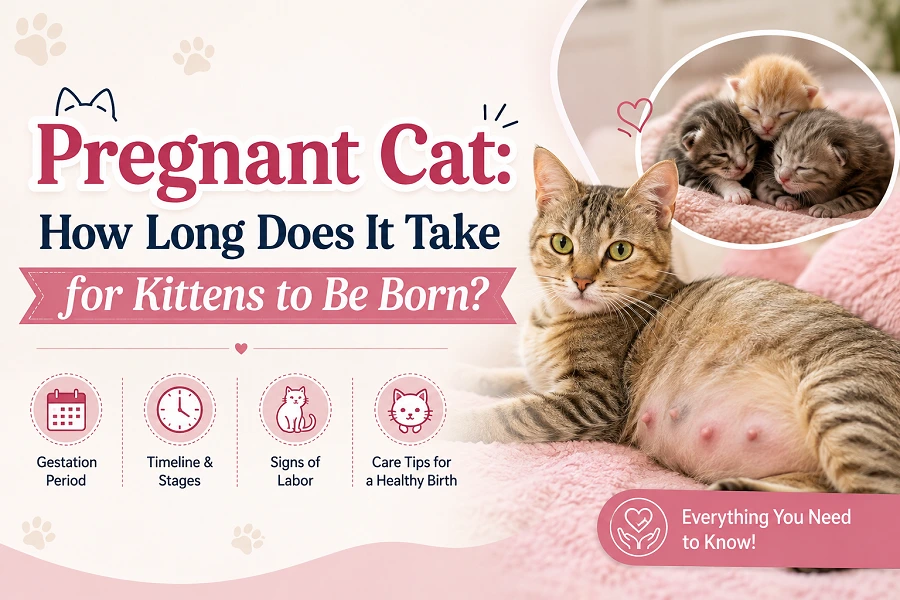
Pregnant Cat: How Long Does It Take for Kittens to Be Born?
My neighbor once called me in a mild panic because her cat, Mishti, had gone from “maybe pregnant” to “definitely pregnant” within what felt like a few weeks. She wanted to know exactly how much time she had to prepare. That question — how long are cats pregnant for — comes up constantly, and the short answer is this:
Cats are pregnant for about 63 to 65 days, roughly 9 weeks, though it can range anywhere from 58 to 70 days depending on the cat and the litter size.
That’s the number to remember. But if you actually want to be ready — food, space, a vet visit or two — you need to know what happens during those nine weeks, not just the final count.
So, How Long Do Cats Stay Pregnant, Exactly?
Unlike dogs, whose pregnancy length can vary a fair bit by breed, cat pregnancy is fairly consistent across most domestic breeds. Whether you’ve got a scrappy street cat or a pedigree Persian, the gestation period sits close to that 63-65 day window.
A few things can nudge the number slightly:
- Larger litters sometimes arrive a day or two early.
- First-time mothers occasionally carry a little longer than experienced ones.
- Breed can play a small role — Siamese cats, for instance, are sometimes reported to have marginally shorter pregnancies, though this isn’t something I’d bank on without a vet confirming dates.
If a cat goes past day 70 without giving birth, that’s worth a vet call. Not panic-worthy immediately, but worth checking.
Cat Pregnancy Timeline, Week by Week
Here’s where it actually gets useful. Knowing the number “63 days” doesn’t tell you what to expect in week 3 versus week 7. This is the breakdown I’d give a friend:
| Week | What’s Happening |
|---|---|
| Week 1–2 | Fertilization occurs; no visible signs yet |
| Week 3 | Nipples may turn pink and enlarge (“pinking up”) — often the first visible clue |
| Week 4 | Mild weight gain begins; possible slight appetite increase |
| Week 5 | Belly starts rounding out; vet can often confirm pregnancy via palpation or ultrasound |
| Week 6 | Noticeable weight gain; kittens may be felt moving on gentle touch |
| Week 7 | Nesting behavior begins — she’ll start seeking quiet, hidden spots |
| Week 8 | Belly is visibly large; she may become restless or clingy |
| Week 9 | Labor typically begins; watch for restlessness, low body temperature, and reduced appetite |
I want to flag something here: not every cat follows this exactly. Some cats show almost no visible signs until week 5 or 6, especially if it’s a small litter (one or two kittens). I’ve seen cats where you genuinely couldn’t tell until the very end. So don’t panic if your cat doesn’t match this table perfectly — it’s a guide, not a rulebook.
How Do You Even Know If a Cat Is Pregnant in the First Place?
Before you’re counting down days, you need confirmation. The early signs are subtle enough that people miss them constantly.
The most reliable early sign is pinking — the nipples become noticeably pink and slightly swollen around week 3. Behavioral changes come next: increased affection, a bigger appetite, sometimes a bit of vomiting (similar to morning sickness, oddly enough).
A vet can confirm pregnancy through:
- Abdominal palpation around day 17–25 (best done by a professional — trying this yourself risks injuring the kittens)
- Ultrasound from around day 21 onward, which can also give a rough idea of litter size
- X-ray later in pregnancy (after day 42 or so) when skeletons are calcified enough to count kittens accurately
Honestly, if you suspect pregnancy, just get an ultrasound around the three-week mark. It’s the least stressful way to get a real answer instead of guessing off nipple color for two more weeks.
What Happens Close to Labor?
In the final week, behavior shifts noticeably. She’ll start “nesting” — scratching at blankets, hiding in closets, or claiming a box you didn’t even know she liked. This is her instinct kicking in to find somewhere safe.
Other signs labor is close:
- A drop in body temperature (below 100°F / 37.8°C), usually 12–24 hours before delivery
- Restlessness or pacing
- Loss of appetite in the final day
- Vocalizing more than usual, sometimes crying softly
Mishti — my neighbor’s cat — went into labor almost exactly on day 64, and the whole thing (start to last kitten) took about five hours for a litter of four. That’s fairly typical, though litters can take anywhere from a couple of hours to over a day if there are complications or a large litter involved.
When Should You Actually Worry?
This is the part people underprepare for. Most cat pregnancies go smoothly with zero intervention needed. But you should call a vet immediately if:
- She’s been in active labor for more than an hour with no kitten delivered
- More than 2–3 hours pass between kittens with visible straining
- There’s heavy bleeding (a little is normal, a lot isn’t)
- She seems distressed, weak, or in obvious pain beyond normal labor discomfort
- Pregnancy goes past day 70 with no signs of labor starting
I’m not a vet, and if something feels off, don’t wait it out hoping it resolves — cat labor complications can escalate quickly, and it’s always cheaper (financially and emotionally) to get checked early than to deal with an emergency at 2 a.m.
A Few Things I’d Tell You Honestly
Cat pregnancy sounds simple on paper — 63 days, done — but in practice, every cat is a little different. Some show clear signs early; others hide it well enough that you’re caught off guard in week 6. If you have an intact female cat and any chance she’s been around an unneutered male, don’t wait for obvious signs. A quick vet visit around the three-week mark saves a lot of guesswork.
Also, worth saying plainly: if you’re not planning to breed, spaying prevents this whole situation and has real health benefits too (lower risk of certain cancers, no heat cycles). Not a lecture, just something worth knowing if this wasn’t planned.
Quick Recap
- Cats are pregnant for 63–65 days on average, with a normal range of 58–70 days
- Early signs show around week 3 (pinking); visible belly growth by week 5–6
- Nesting behavior signals labor is close, usually in the final week
- A vet ultrasound around 3 weeks gives the most reliable confirmation
- Anything past day 70, or labor lasting too long between kittens, needs a vet call
Frequently Asked Questions
1. How long are cats pregnant for on average?
Cat pregnancy typically lasts 63 to 65 days, or roughly nine weeks, from conception to delivery.
2. How long is a cat pregnant compared to a dog?
Cats and dogs have similar gestation periods, both averaging around 63 days, though dog pregnancy length can vary more by breed size.
3. Can a cat’s pregnancy last longer than 65 days?
Yes, some pregnancies extend to 68–70 days, especially with smaller litters. Beyond day 70 without labor starting is a reason to contact a vet.
4. How can I tell how many weeks pregnant my cat is?
The clearest early marker is nipple “pinking” around week 3. A vet ultrasound around week 3–4 can more precisely estimate gestational age.
5. Do cats show pregnancy signs early on?
Not always. Some cats show visible signs (belly growth, pinking) by week 3–4, while others, especially with small litters, may not show much until week 5 or 6.
6. How many kittens do cats usually have?
The average litter size is 4 to 6 kittens, though first litters are sometimes smaller, and litters can range from 1 to as many as 8 or more.
7. Can I feel the kittens moving before birth?
Yes, gentle movement can sometimes be felt or seen through the belly from around week 6 onward, though this varies by cat and litter size.
8. What does nesting behavior look like in cats?
She’ll seek out quiet, enclosed spaces — closets, boxes, under furniture — usually starting in the final week of pregnancy.
9. How long does actual labor take once it starts?
Labor typically lasts a few hours for the full litter, though it can range from under an hour to over 24 hours depending on litter size and complications.
10. Is it safe to feel a cat’s belly to check for kittens?
It’s best left to a vet. Amateur palpation done incorrectly can risk injury to the developing kittens, especially in early pregnancy.
11. How do I know if my cat’s pregnancy has complications?
Signs include prolonged labor with no kitten delivered, heavy bleeding, visible distress, or pregnancy extending well past day 65 without labor starting.
12. Can a cat get pregnant again right after giving birth?
Yes — cats can go into heat again within weeks of giving birth, even while nursing, which is why spaying is recommended if you’re not planning further litters.
13. What should I feed a pregnant cat?
Most vets recommend gradually switching to a high-quality kitten food during pregnancy, as it’s calorie-dense and supports the nutritional demands of gestation and nursing.
14. How long after mating does a cat show signs of pregnancy?
Physical signs typically don’t appear until around week 3, though hormonal changes begin immediately after successful mating.
15. Do indoor cats need a vet check during pregnancy?
Yes, at least one check-up (ideally around week 3–4) is recommended to confirm pregnancy, estimate litter size, and rule out complications.