
 By guestpostupmy@gmail.com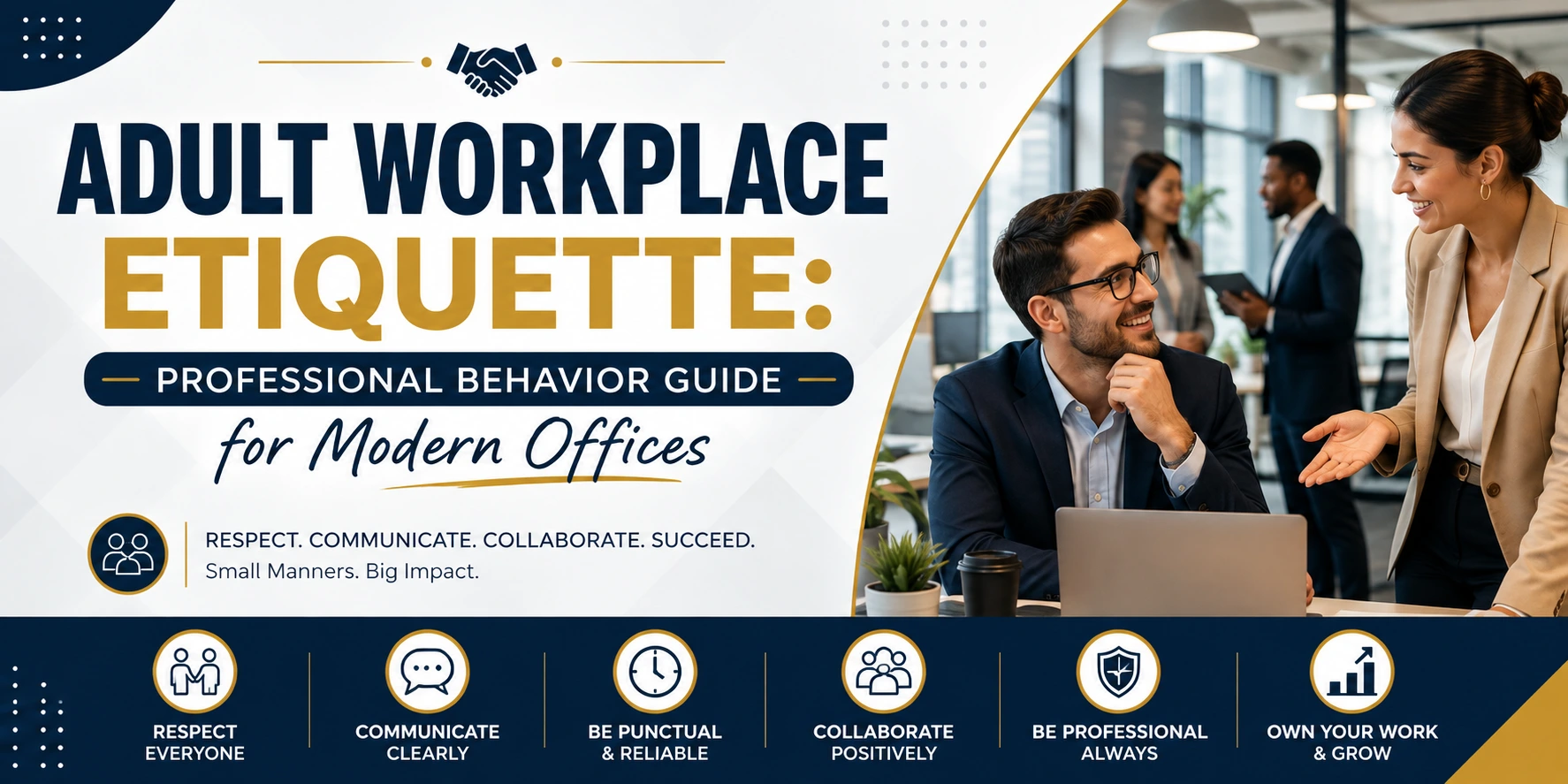
Why “Adult Workplace” Behavior Still Needs a Rulebook
Here’s something nobody tells you when you start your first real job: being a grown-up doesn’t automatically make you good at working with other grown-ups.
I’ve sat in on enough team meetings — and made enough of my own mistakes early on — to know that the adult workplace runs on a set of unwritten rules that almost nobody explains out loud. You’re expected to know how to give feedback without sounding harsh, how to disagree with your boss without torching the relationship, and how to handle the coworker who “jokes” a little too much at your expense. Nobody hands you a manual for that on day one. This article is the manual I wish someone had handed me.
We’ll cover the basics of professional conduct, but we’ll also get into three things that rarely show up in generic etiquette lists: how adults actually learn new skills on the job, why bullying still happens between grown adults who should know better, and how neurodivergent employees — including adults with ADHD — often bring strengths that traditional offices overlook.
The Foundations of Professional Behavior in Modern Offices
Let’s start simple, because the basics matter more than people admit.
- Show up when you say you will. Reliability is still the single most underrated trait in any workplace. It builds trust faster than charisma ever will.
- Communicate like the other person’s time matters. That means shorter emails, clearer subject lines, and not CC’ing six people on something that needed one.
- Disagree with the idea, not the person. “I see it differently” lands very differently than “that’s wrong.”
- Read the room before you read the policy. A hybrid office in 2026 has different norms than the cubicle farm your parents worked in. Slack tone, video call etiquette, and how quickly you’re expected to respond after hours — these are cultural, not written down anywhere.
One thing I’ve noticed working alongside younger teams: etiquette isn’t fixed anymore. What counted as rude ten years ago (texting during a meeting) is now just how some teams coordinate logistics. The point isn’t memorizing rules — it’s paying attention to your specific office and adjusting.
How Adults Learn in the Workplace (And Why It’s Different From School)
Adults don’t learn the way kids do, and pretending otherwise is why so much corporate training gets ignored.
There’s a well-known idea in adult education called andragogy — basically, the study of how grown-ups learn best. The short version: adults want to know why they’re learning something before they’ll invest in it. They learn best when new information connects to something they already know, and they tune out fast when training feels irrelevant to their actual job.
I once sat through a two-hour compliance training that opened with “By the end of this session, you will understand…” and I watched three people quietly start answering emails within the first ten minutes. Compare that to a manager I worked with who opened a similar session with “Here’s the actual mistake that cost our team $40,000 last quarter — let’s make sure it doesn’t happen again.” Same content, completely different room energy.
Adults also learn better through doing than through listening. If you’re trying to build a skill, watching a slideshow gets you maybe 20% of the way there; practicing the actual task gets you the rest.
How to Train Adults in the Workplace Effectively
If you’re the one designing training — whether it’s onboarding a new hire or rolling out a new tool to the whole team — a few things consistently work better than the standard lecture-and-quiz format:
- Start with the problem, not the process. Show people what breaks if they don’t learn this.
- Keep sessions short and spaced out. A 90-minute info dump loses people after minute 20. Three 30-minute sessions over two weeks beats one long one almost every time.
- Let people practice immediately. Don’t train on Monday and expect application three weeks later — the gap kills retention.
- Build in real feedback, not just a certificate of completion. A quick “here’s what you did well, here’s what to adjust” is worth more than any quiz score.
- Respect that adults have outside lives. Mandatory 7 a.m. trainings before school drop-off, or 6 p.m. sessions that eat into someone’s evening, breed resentment fast — and resentment kills learning.
Training adults isn’t about dumbing things down. It’s about respecting that they’ve already got a full mental plate and need a reason to make room for something new.
ADHD Adults in the Workplace: Strengths That Get Overlooked
This one deserves its own honest section, because most workplace guides either ignore neurodivergence entirely or treat it purely as a limitation to accommodate.
Adults with ADHD often bring real strengths to a job — hyperfocus on problems they care about, fast pattern recognition, and a willingness to try unconventional approaches when the standard process isn’t working. It’s part of why you’ll find a disproportionate number of ADHD adults drawn to entrepreneurship — the ability to juggle multiple threads, tolerate risk, and pivot quickly maps well onto building something from scratch, even if the same traits can feel chaotic in a rigid nine-to-five structure.
That said, I’m not going to oversell this. ADHD in a traditional office can also mean genuine struggles with time-blindness, prioritization, or sitting through a two-hour status meeting that could’ve been an email. The workplaces that get the most out of ADHD employees aren’t the ones that ignore the challenges — they’re the ones that offer flexibility on how work gets done (clear written instructions instead of only verbal ones, permission to use noise-cancelling headphones, deadlines broken into smaller checkpoints) while still holding people accountable for outcomes. Productivity for an ADHD adult often looks less like a tidy 9-to-5 rhythm and more like intense bursts of output — and a good manager learns to work with that rhythm instead of fighting it.
Why Do Adults Bully in the Workplace?
This is the uncomfortable part of the adult workplace conversation that most etiquette guides skip entirely.
Adult bullying at work rarely looks like the schoolyard version. It’s the manager who publicly humiliates someone in a meeting “for their own good.” It’s the coworker who excludes a colleague from key emails on purpose. It’s the passive-aggressive Slack message copied to the whole team instead of a private word.
Why does it happen among people who are, on paper, professionals? A few honest reasons:
- Insecurity dressed up as authority. Bullying often comes from people who feel threatened by someone more competent or well-liked.
- Unchecked power. When there’s no real consequence for bad behavior — especially from someone senior — it repeats.
- Workplace culture that rewards results over conduct. If a bully hits their numbers, companies often look the other way.
- It’s learned. People who were managed poorly often manage the same way, without realizing it.
I’ve watched a talented employee quit a job not because of the workload, but because a manager belittled her in front of clients twice and HR treated it as a “personality clash.” That’s the reality — a lot of workplace bullying survives because it’s misfiled as conflict instead of named for what it is.
If you’re dealing with it: document everything with dates and specifics, loop in HR in writing (not just verbally), and don’t assume it’ll resolve itself just because everyone involved is an adult. Adulthood doesn’t cure bad behavior — accountability does.
A Few Honest Caveats
No etiquette guide fixes a toxic culture. If leadership tolerates bullying or treats training as a checkbox, individual good behavior only goes so far. And flexibility for neurodivergent employees works best when it’s built into policy, not left to whichever manager happens to be understanding that year. Real change here is structural, not just personal.
Final Thought
Adult workplace etiquette isn’t about being stiff or overly formal — it’s about basic respect, applied consistently, even when nobody’s watching. Learn how your colleagues actually absorb information, train people like their time matters, recognize the strengths neurodivergent coworkers bring, and don’t let bad behavior hide behind the excuse that “everyone’s an adult here.” Because being an adult was never the hard part — acting like one, consistently, is.
FAQs
1. What is considered proper adult workplace etiquette?
It includes punctuality, clear communication, respecting boundaries, giving constructive feedback, and treating colleagues professionally regardless of rank.
2. How is adult workplace etiquette different from general office rules?
General office rules are often written policy. Adult workplace etiquette covers the unwritten, cultural expectations — tone, timing, and interpersonal respect — that policy doesn’t capture.
3. How do adults learn best in the workplace?
Adults learn best when training connects to real problems, offers hands-on practice, and respects their existing knowledge and time constraints.
4. Why does traditional classroom-style training fail with adult employees?
Because it doesn’t explain relevance upfront and relies too heavily on passive listening instead of active practice.
5. What’s the best way to train adults in the workplace?
Short, spaced-out sessions with immediate practice and real feedback work better than long, one-time lectures.
6. Do adults with ADHD struggle more in traditional office settings?
Some do, particularly with rigid schedules and long meetings, but many also bring strengths like hyperfocus, creative problem-solving, and adaptability.
7. Why are many ADHD adults drawn to entrepreneurship?
Entrepreneurship often rewards traits like fast pivoting, risk tolerance, and intense bursts of focus — which align well with how many ADHD brains work.
8. How can workplaces support ADHD employees without lowering standards?
By offering flexibility in how work is done (written instructions, flexible deadlines, quiet workspaces) while still holding people accountable for results.
9. Why do adults bully coworkers at work?
Common reasons include insecurity, unchecked authority, a results-over-conduct culture, and bullying behavior learned from past bad managers.
10. What does adult bullying at work actually look like?
It’s often subtle — public humiliation, exclusion from communication, passive-aggressive messaging, or persistent undermining rather than outright confrontation.
11. How should I respond if I’m being bullied at work?
Document specific incidents with dates, report it to HR in writing, and seek support from trusted colleagues or a mentor rather than assuming it will resolve on its own.
12. Can adult workplace etiquette be taught, or is it just common sense?
It can absolutely be taught — many people simply were never shown these norms explicitly, especially early in their careers.
13. Does remote or hybrid work change adult workplace etiquette?
Yes. Response-time expectations, video call norms, and communication tone shift significantly compared to fully in-person offices.
14. Is workplace bullying always intentional?
Not always. Some of it stems from learned management habits rather than deliberate malice, though the impact on the target is the same either way.
15. What’s one sign of good adult workplace etiquette that’s often overlooked?
Giving credit publicly and criticism privately — a small habit that says a lot about someone’s professionalism.