
 By user
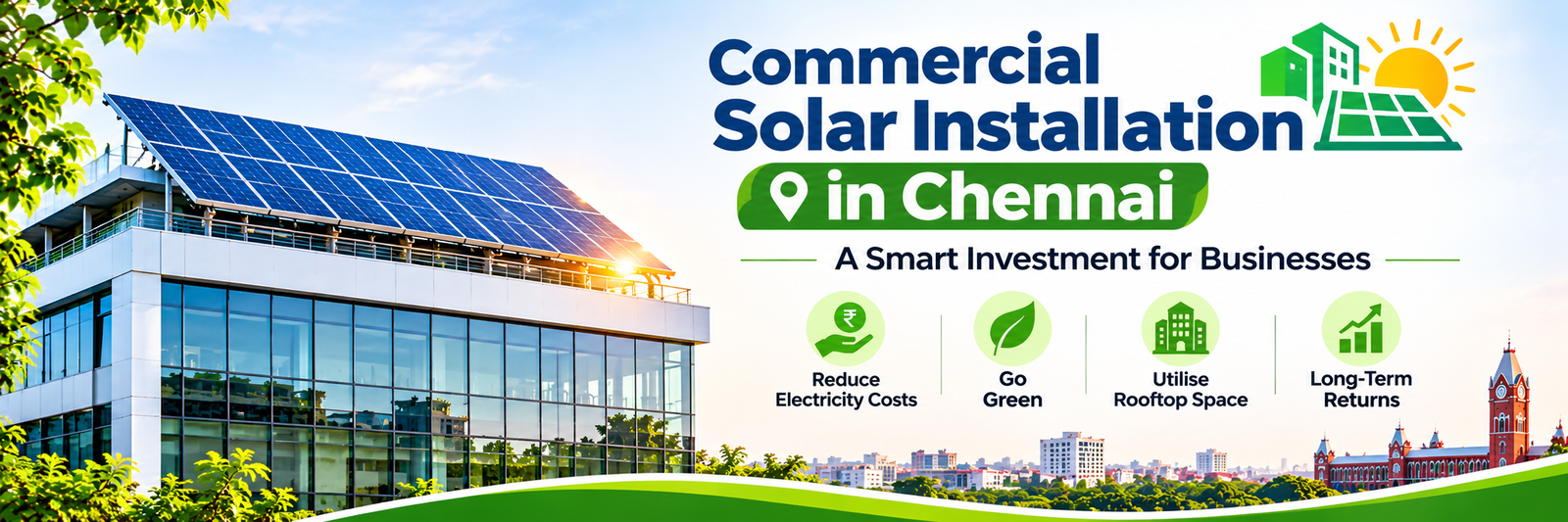
For businesses in Chennai, electricity is one of the recurring operating expenses that can significantly affect monthly budgets. Offices, hotels, hospitals, factories, warehouses, educational institutions, retail establishments, and commercial buildings often consume large amounts of electricity every day. As energy costs and sustainability requirements become increasingly important, commercial solar installation in Chennai is emerging as a practical solution for businesses looking to improve energy efficiency and reduce long-term electricity expenses.
Chennai’s strong solar potential makes rooftop and ground-mounted solar power systems suitable for many commercial properties. By using available roof space to generate clean electricity, businesses can reduce their dependence on conventional grid power and move towards a more sustainable energy model.
What Is Commercial Solar Installation?
Commercial solar installation involves designing and installing a solar power system specifically for business and commercial applications.
Unlike small residential systems, commercial solar projects are generally designed around higher electricity consumption and larger available installation areas. A typical commercial solar system may include:
- High-efficiency solar panels
- Solar inverters
- Mounting structures
- DC and AC protection systems
- Monitoring equipment
- Electrical distribution systems
- Required cabling and safety components
The system capacity is determined based on the business’s electricity consumption, available installation area, operating requirements, and other technical factors.
Why Choose Commercial Solar Installation in Chennai?
Chennai has favourable solar conditions for businesses interested in generating renewable electricity. Commercial properties with large rooftops can make productive use of otherwise unused space.
The primary reasons businesses consider solar power include:
1. Reduce Electricity Expenses
Commercial establishments often have substantial electricity consumption. Solar power can generate electricity during daylight hours and reduce the amount of energy that needs to be purchased from the grid, depending on the system configuration and applicable electricity regulations.
2. Utilise Available Rooftop Space
Large commercial buildings frequently have unused rooftop areas. Installing solar panels allows businesses to convert this space into an energy-generating asset.
3. Support Sustainable Business Practices
Solar energy is a renewable source of power. Businesses adopting solar can reduce their dependence on conventional energy sources and strengthen their environmental sustainability initiatives.
4. Improve Long-Term Energy Planning
Electricity costs can represent a significant operational expense. Generating a portion of electricity onsite can provide businesses with greater control over their long-term energy strategy.
5. Strengthen Corporate Sustainability
Companies increasingly focus on ESG, sustainability, and responsible energy consumption. Commercial solar can become an important component of a company’s broader sustainability strategy.
Which Businesses Can Benefit from Commercial Solar?
Commercial solar power is not limited to one type of business. Different organisations can evaluate solar based on their electricity requirements and available space.
Potential applications include:
- Hotels and resorts
- Hospitals and healthcare facilities
- Corporate offices
- Manufacturing units
- Warehouses
- Shopping complexes
- Educational institutions
- Restaurants
- Retail buildings
- Apartment common facilities
- IT and commercial campuses
For businesses with high daytime electricity consumption, solar can be particularly relevant because electricity generated during daylight hours can be used directly within the facility, subject to the system design.
How Does a Commercial Solar System Work?
Solar panels installed on the roof or other suitable areas capture sunlight and convert it into DC electricity. A solar inverter then converts the generated electricity into AC electricity suitable for use within the commercial facility.
The basic process is:
Sunlight → Solar Panels → DC Electricity → Inverter → AC Electricity → Business Operations
Depending on the project requirements, the system may be connected to the grid and can also be integrated with battery energy storage solutions where appropriate.
Choosing the Right Commercial Solar System
Every business has different electricity requirements. Therefore, choosing a solar system simply based on available rooftop space may not provide the most effective solution.
A professional assessment should consider:
- Monthly electricity consumption
- Peak electrical demand
- Daytime energy usage
- Available rooftop area
- Roof structure and condition
- Shading from nearby buildings
- Solar panel orientation
- Inverter capacity
- Electrical infrastructure
- Future expansion plans
- Maintenance requirements
A detailed energy assessment helps determine the appropriate system configuration for the business.
Commercial Rooftop Solar Installation Process
A professional commercial rooftop solar installation in Chennai generally follows several stages.
Site Assessment
The solar team evaluates the building, rooftop condition, available space, shading, electrical infrastructure, and safety requirements.
Energy Analysis
Historical electricity bills and consumption patterns are analysed to understand the business’s energy requirements.
System Design
The solar system is designed based on electricity consumption, available space, expected generation, and technical requirements.
Component Selection
Solar panels, inverters, mounting structures, protection equipment, and other components are selected according to the project’s requirements.
Installation
The solar panels and supporting equipment are installed according to the approved design.
Testing and Commissioning
The completed system undergoes electrical testing and commissioning before being placed into operation.
Monitoring and Maintenance
Performance can be monitored to identify generation issues and maintain the system’s efficiency over time.
Why Professional Installation Matters
Commercial solar systems involve significant electrical infrastructure and investment. Poor system design or installation can affect safety, performance, and long-term reliability.
Working with an experienced solar solution provider can help businesses address important areas such as system sizing, electrical integration, structural requirements, protection systems, and maintenance.
Businesses should also evaluate the quality of components, installation experience, warranty support, documentation, and after-sales service before selecting a solar provider.
Commercial Solar and Return on Investment
One of the most important questions for a business is whether solar installation makes financial sense.
The potential return on investment depends on several factors, including:
- Total system cost
- Solar system capacity
- Electricity consumption
- Electricity tariff
- Solar generation
- Daytime energy usage
- Financing arrangements
- Maintenance costs
- Applicable government policies or incentives
For this reason, businesses should obtain a customised project assessment instead of relying on generic savings calculations.
Why Choose Sree Nandhee’s Technologies Pvt. Ltd.?
Businesses looking for commercial solar installation in Chennai need a solar partner capable of understanding both technical requirements and commercial objectives.
Sree Nandhee’s Technologies Pvt. Ltd. provides solar solutions designed around the energy requirements of businesses and commercial properties. The company focuses on understanding the customer’s electricity usage, assessing the installation site, and developing suitable solar power solutions.
From commercial rooftop solar projects to larger business energy requirements, a professional approach can help organisations make better decisions regarding system capacity, installation, performance, and long-term energy management.
Is Commercial Solar a Smart Investment for Chennai Businesses?
For many businesses, solar power can be an effective long-term energy strategy. Chennai’s solar potential, combined with the availability of commercial rooftops and increasing focus on energy efficiency, makes commercial solar an option worth evaluating.
However, the right system depends on the individual property’s electricity consumption, available space, operating schedule, and financial objectives.
Businesses should therefore begin with a professional site assessment and energy analysis before making an investment decision.
Conclusion
Commercial solar installation in Chennai offers businesses an opportunity to generate renewable electricity while potentially reducing their dependence on conventional grid power. From offices and hotels to factories, warehouses, hospitals, and educational institutions, a properly designed solar system can support both energy management and sustainability goals.
With the right system design, quality components, professional installation, and ongoing maintenance, commercial solar can become a valuable long-term energy asset.
For businesses considering a transition towards solar power, Sree Nandhee’s Technologies Pvt. Ltd. can help assess commercial energy requirements and explore suitable solar solutions for their property.