
 By user
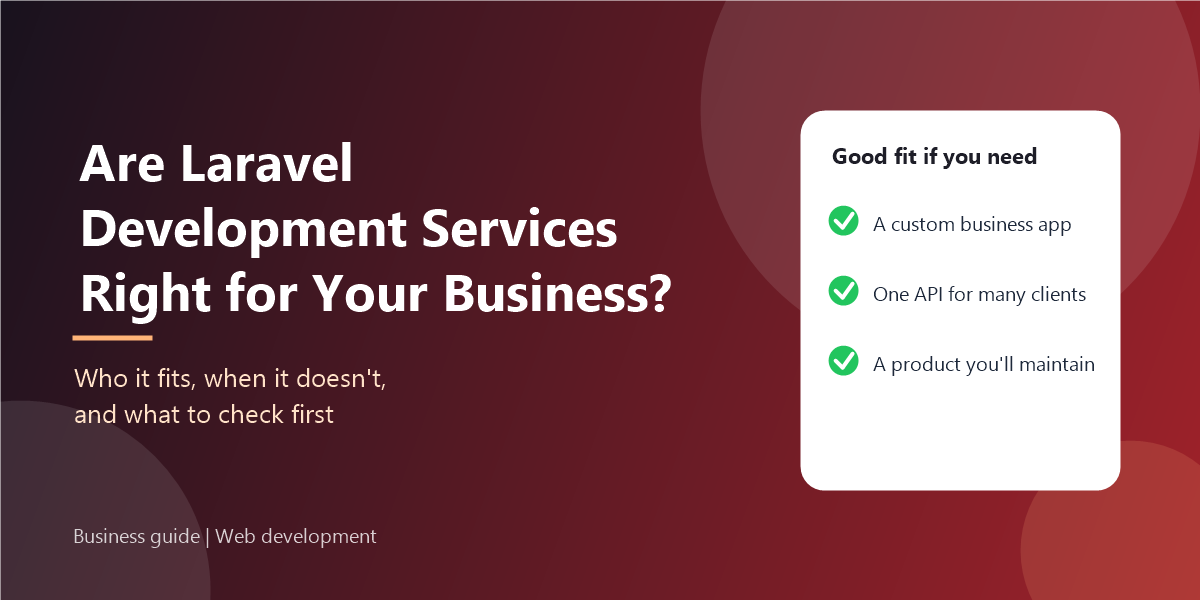
Laravel development services suit businesses that need a custom web application, API, or maintained back-end platform. They’re a weaker fit for simple brochure sites, short one-off projects, or teams already running another stack well. The right answer depends on product complexity, internal ownership, and how long you’ll maintain the software.
What Laravel offers a business
Laravel is a PHP framework with mature tools for routing, authentication, database work, background jobs, and automated testing. A laravel development company uses those tools to turn your business rules into software, which matters most when your processes are specific to your industry.
Three features matter most in practice. Queues move slow tasks, such as sending invoices or processing large imports, out of the request cycle so users aren’t left waiting. Policies control who can view or change each record. Eloquent, Laravel’s database layer, models relationships between customers, orders, and invoices, so your team doesn’t write raw SQL for every report.
When Laravel development services make sense
Laravel tends to be the right call when:
- You need a custom business application, such as a client portal, booking system, internal operations tool, or subscription platform.
- Your product relies on user roles, structured data, and business rules that change over time.
- You need one API to serve a web app, a mobile app, and third-party integrations.
- You want a framework with strong documentation, a large community, and a clear upgrade path.
A realistic example
Take a hypothetical regional distributor that tracks orders in spreadsheets and email. It needs a portal where dealers place orders, check inventory, and download invoices, plus an admin panel for staff. Laravel fits this kind of project well. The business rules are specific, the data is relational, and the system has to grow with the company. A good provider would start with a short discovery phase to map the order process before writing any code.
What a typical engagement covers
A well-run Laravel project usually moves through five stages:
- Discovery: Map the workflows, users, data, and integrations. The output is a scope document and a prioritized feature list.
- Architecture: Decide on the database design, authentication model, hosting setup, and how third-party services connect.
- Iterative build: Deliver working features in short cycles, with automated tests written alongside the code rather than at the end.
- Launch and handover: Set up deployment, document the system, and transfer access to accounts you own.
Ongoing support. Apply security patches, plan framework upgrades, and monitor queues and performance.
Ask providers to describe each stage in their own words. Vague answers at this point usually predict vague delivery later.
When they are probably not the right fit
Laravel is a capable framework, but it isn’t the answer to every problem. Look elsewhere if:
- You need a simple marketing site: A website builder or static site generator is faster and cheaper.
- The project is a short experiment: Proper architecture takes time, which may outweigh the benefit of a quick test.
- Your team already standardizes on another stack: Adding PHP creates hiring, tooling, and knowledge-sharing costs.
- Your core product depends on heavy real-time or data-intensive processing: You may need specialized infrastructure or a different back end.
Edge cases to plan for
Even a good fit can go wrong. Queued jobs can fail silently if nobody monitors them. Pages slow down when database queries aren’t reviewed as data grows. And if no one inside your company understands the codebase, you depend entirely on your provider. Before signing, set up monitoring, require documented code, and agree on who can make changes in an emergency. Plan for framework upgrades too. Major releases occasionally change APIs, so budget time for them every year.
Laravel development services vs. building in-house
Use this comparison to decide which route fits your situation.
| Factor | Laravel development services (agency or contractor) | In-house team |
|---|---|---|
| Speed to start | Usually faster once scope is agreed | Slower; depends on hiring |
| Cost structure | Project or retainer based, varies with scope | Fixed salaries plus overhead |
| Product knowledge | Builds over time; slower at first | Builds continuously |
| Scaling effort | Easier to add or reduce capacity | Harder to flex up or down |
| Long-term ownership | Depends on contract and handover terms | Fully internal |
| Best for | Launches, specialized work, peak workloads | Core products with steady development |
Many businesses combine the two: an internal product owner sets priorities, and an external team handles build-out and surge capacity. Teams comparing Laravel development services in the USA should also check time zone overlap and working hours, since a provider on a different schedule can slow down decisions.
How to evaluate a provider
Look for evidence, not promises:
- Ask for examples of Laravel applications similar to yours, and ask what went wrong and how they fixed it.
- Confirm who will work on your project, not only who sells it.
- Ask how they write tests, review code, and deploy changes.
- Confirm you own the source code, repository, hosting, and domain accounts.
- Ask what post-launch support includes and how they handle framework upgrades.
- Request a small paid discovery phase before committing to a full contract.
Red flags
Be cautious of fixed-price offers made before requirements are defined, examples with no tests, and vague answers about handover or deployment.
How to decide in three steps
- Define the job: Write down the business problem, the users, and the features that must exist at launch.
- Confirm ownership: Decide who will own the product after launch. If no one inside can, budget for a long-term support arrangement.
- Test the fit: A two-to-four-week pilot shows how a provider communicates, estimates, and delivers.
Laravel development services are usually a sound choice for a custom, data-driven application with a clear internal owner. For a simple site, a one-time experiment, or a product your team already builds in another stack, look elsewhere.
Your next step: write a one-page brief covering the problem, the users, and the must-have features. Then send it to two or three providers and compare how each one responds.
 guestpostupmy@gmail.com