
 By user
A Limited Liability Partnership (LLP) blends the operational flexibility of a traditional partnership with the limited liability protection of a corporate entity. Governed by the Limited Liability Partnership Act, 2008 and administered by the Ministry of Corporate Affairs (MCA), an LLP operates as a separate legal entity capable of entering contracts, owning property, and suing or being sued in its own name. Unlike conventional partnership firms where partners face unlimited personal liability for business obligations, LLP partners generally risk only their agreed capital contributions. Understanding the eligibility rules and baseline requirements before starting helps founders avoid filing rejections, delays, and compliance penalties.
An LLP model works well for professional service firms, consultancies, agencies, and SMEs. It offers clear profit-sharing rules without heavy corporate board formalities. While Llp Registration India is completed digitally through the MCA21 portal, applicants must satisfy statutory partner rules, secure digital credentials, provide valid premises documentation, and draft a formal partnership agreement. The sections below detail who qualifies to form an LLP and what foundational requirements apply.
Who Is Eligible to Form an LLP?
Any individual or body corporate with legal capacity to enter into a contract can become a partner in an LLP, subject to statutory conditions under the LLP Act, 2008. Foreign nationals, Non-Resident Indians (NRIs), and foreign corporate entities can also participate. However, they must meet the applicable rules. They must also follow Foreign Direct Investment (FDI) norms for the proposed sector.
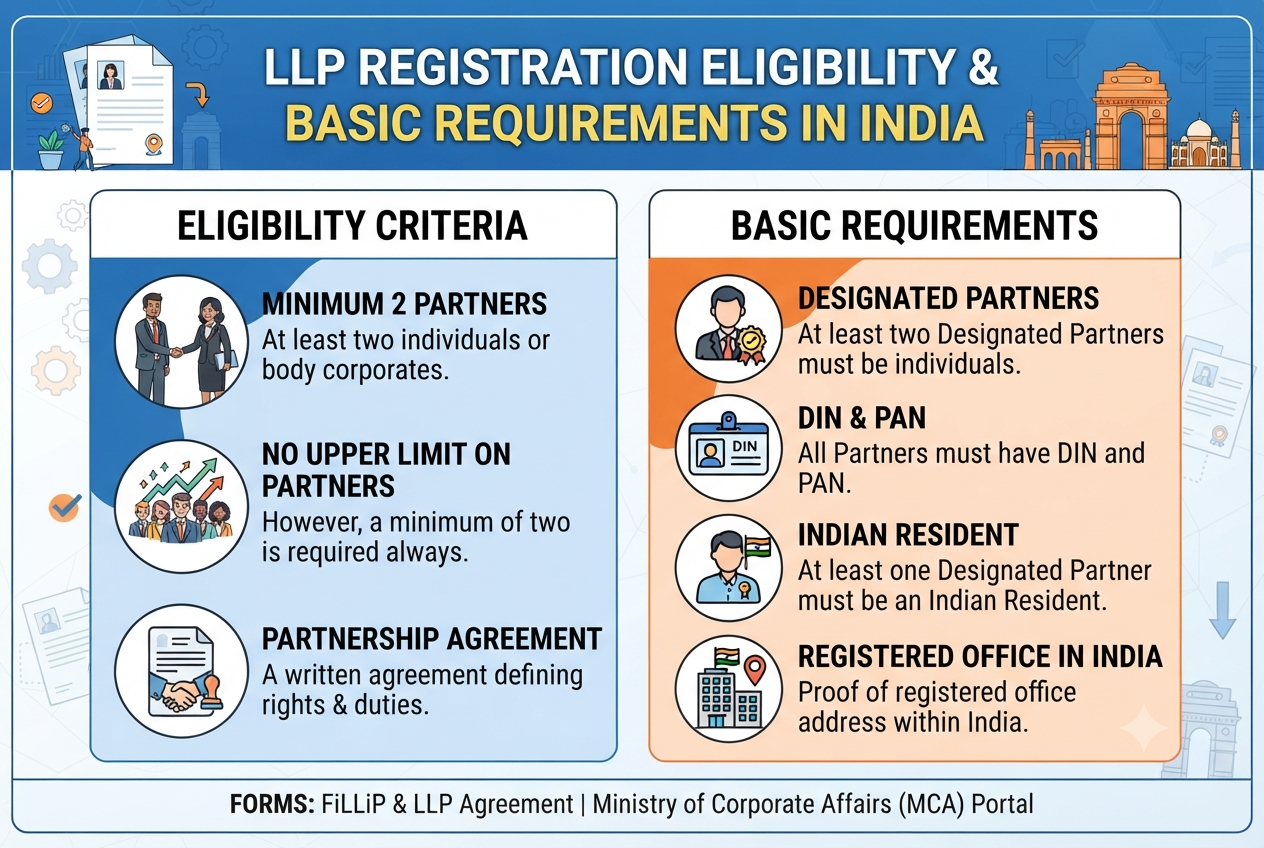
- Minimum and Maximum Partners: An LLP requires at least two partners at all times. Under the LLP Act, 2008, there is no upper ceiling on the total number of partners an LLP can admit. An LLP must have at least two partners. If the count drops below two and the LLP carries on business alone for more than six months, personal liability can apply. In that case, the sole remaining partner can become personally liable for obligations incurred after the six-month mark.
- Designated Partners and Residency Rule: Every LLP must appoint at least two designated partners who are individuals, and at least one of them must be a resident of India. A resident in India generally refers to a person who has stayed in India for at least 120 days during the relevant financial year. Designated partners carry direct legal responsibility for regulatory filings, compliance, and penalties under the Act.
- Legal Capacity and Disqualifications: Individual partners must be at least 18 years old and of sound mind. Individuals who are undischarged insolvents—or have applied to be declared insolvent—are ineligible. Those barred by a court from acting as directors or designated partners are also disqualified.
- Corporate and Foreign Partners: Domestic companies, existing LLPs, and foreign body corporates may act as partners. If a body corporate is a partner, it must nominate an individual to act on its behalf. Additionally, foreign nationals or NRIs must meet apostille or notarization rules for overseas identity and address records.
Core Structural and Filing Requirements
Before submitting incorporation forms electronically, founders must put several structural and documentation elements in place. Even minor discrepancies across forms and identity records can trigger resubmissions.
- No Minimum Capital Requirement: Indian law does not prescribe a minimum capital contribution to register an LLP. Partners can contribute cash, tangible assets, or intangible value as mutually agreed, with stamp duty payable on the capital contribution recorded in the LLP agreement.
- Unique Proposed Name: The proposed name must not be identical or deceptively similar to an existing LLP, company, or registered trademark, and it must end with “LLP” or “Limited Liability Partnership.” Names are reserved through the MCA web service (RUN-LLP or within the incorporation filing) and must align with permitted business activities.
- Registered Office in India: Every LLP needs a registered office address in India to receive official notices and correspondence from the Registrar of Companies (RoC) and statutory authorities. Applicants typically submit a recent utility bill, such as an electricity, water, or telephone bill. The bill must generally be no older than two months. They must also provide proof of ownership, or a lease agreement with a No Objection Certificate (NOC) from the property owner.
- Class 3 Digital Signature Certificates (DSC): Because MCA filings are electronic, proposed designated partners obtain Class 3 DSCs from licensed certifying authorities to digitally sign incorporation and compliance documents.
- Designated Partner Identification Number (DPIN): Designated partners require a DPIN (or an existing Director Identification Number, DIN, where applicable). During incorporation via Form FiLLiP, DPINs can be allotted for eligible designated partners alongside incorporation and PAN/TAN issuance.
- Partner Identity and Address Proofs: Indian applicants provide PAN cards along with identity and address proofs such as Aadhaar, voter ID, driving license, or passport, plus passport-sized photographs. Foreign nationals and NRIs provide notarized and apostilled passport and overseas address proofs.
Post-Incorporation Essentials and Ongoing Obligations
Receiving the Certificate of Incorporation and LLPIN legally establishes your entity. However, your initial setup isn’t finished yet. Partners must execute a formal LLP Agreement. This agreement sets out capital contributions, profit-and-loss sharing ratios, admission or retirement rules, and partner duties. After signing it, partners must file the agreement with the MCA. This filing typically uses Form 3 within 30 days of incorporation. Missing this deadline attracts daily late fees.
Once incorporated, the LLP opens a current bank account in its own name. It also maintains proper books of account on an ongoing basis. The LLP must meet recurring statutory filings every year. These include Form 11 for the Annual Return and Form 8 for the Statement of Account and Solvency. Partners must also complete KYC updates and file income tax returns on time. Statutory audit requirements apply if turnover exceeds ₹40 lakh or capital contribution exceeds ₹25 lakh. Separate registrations, such as GST or MSME, depend on your specific operations and turnover. Follow these eligibility rules and basic requirements from day one. It keeps your Llp Registration In India smooth, compliant, and built for long-term growth.